
Starbucks Rewards Games
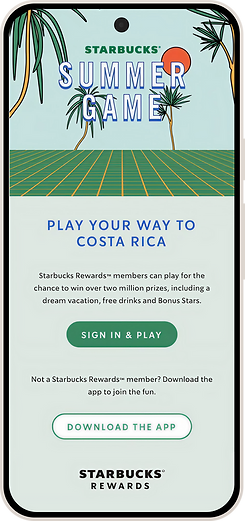
As a Senior Digital Producer, I was responsible for the delivery of UX and design for Starbucks Rewards games, which were engaging mobile games that offered customers the chance to win prizes like free beverages, coupons and trips by making purchases in-store.
Additionally, I built the program processes and tools to improve the quality of design and increase production efficiency.
.png)
OPPORTUNITY
Starbucks Rewards games were being developed in an ad hoc fashion, with no processes in-place to capture learnings, guidelines or tools to create consistency, or dedicated resources to act as domain experts. Taking these considerations into account, I began work on a "blueprint" for delivering games in a scaled manner, focusing on the following opportunity areas:
1. Resourcing
Define and secure dedicated game design resources
2. Workflow tooling
Implement the rights tools for the work and define team workflows
3. Toolkits and guidelines
Build toolkits and guidelines to move faster and more consistently
RESOURCING

I creating a resource estimation spreadsheet showing the % allocation needed by week for each role, by game type. This data was based on past games' metrics and the results of a workshop to create a standardized estimation framework.

Next, I partnered with the business lead to create a program schedule based on the estimates for the next fiscal year, to demonstrate how much overlap there would be in a given month of concurrent game activities in order to meet the desired goal of 10 games released per year.
With this roadmap and resource estimates we were able to review and gain alignment with creative studio and business leadership and secure a dedicated team to support games moving forward.
WORKFLOW TOOLING

Existing project management tools in the creative studio had been selected to support in-store signage workflows, and we needed a better tool to manage a high volume of tickets with customization and flexibility to support digital production workflows.
I was able to secure access to Jira initially, which was in-use by our development teams, and leveraged its Kanban views to keep the team organized and work moving forward. We eventually migrated to Trello, which at the time was a better option for design project management.
TOOLKITS & GUIDELINES


I created this onboarding document in partnership with the games ACD to help designers and copywriters understand the process and approach when working on a game for the first time. It linked to resources we built including a UI/UX toolkit in Zeplin, reusable animation assets and Illustrator templates to create production-ready illustrations for development partners. This was our source of truth and playbook for building new games, and captured learnings from past games to apply forward.
RESULTS
-
Games were delivered on-time and under budget
-
Flexible project management approach accommodated up to three games concurrently
-
Result I'm most proud of: there was a waiting list for designers and copywriters to work on games, as they had a reputation for being well-run and fun with lots of opportunity for creative expression